
How Facebook, Snapchat, TBH, Gas and BeReal Spread School by School
Many of the social apps that won young users didn't launch everywhere at once. They launched one school at a time. Here's what the record shows about Facebook, Snapchat, TBH, Gas, BeReal and Yik Yak, and the lessons we're applying at Portal.
Consumer social has a recurring pattern that's easy to miss if you only look at download charts. Many of the apps that broke through with young people didn't launch to everyone. They launched to one school, or one set of schools, and expanded from there.
Here's what the public record shows about five of them, plus Yik Yak, and what we think the lessons are.
Facebook: one campus, then the next
Facebook launched at Harvard in February 2004. A month later it opened to students at other universities, starting with a short list of schools. High school students got access in September 2005, and it opened to anyone 13 and older in September 2006.
Two things stand out:
- Each campus was a closed network. Joining required a school email, so the people you saw were people you might actually know.
- Expansion was paced, not a big bang. Facebook added schools in batches over more than two years before opening to the public.
Snapchat: a high school found it first
Snapchat's early story, as reported by Forbes, runs through a single high school in Orange County, California. Evan Spiegel's mother told his cousin about the app, and students at her school picked it up on their school-issued iPads, where Facebook was blocked.
Disappearing photos turned out to be perfect for passing notes in class. Forbes reported that early usage peaked between 9 a.m. and 3 p.m., which is to say: school hours. Growth then accelerated after many students got new iPhones over the holidays.
The lesson isn't "target high schools." It's that the product fit a specific, daily behavior inside a dense social group.
TBH: one school in Georgia
TBH was an anonymous compliment polling app for teens, launched in 2017 by a team that included Nikita Bier. In Facebook's acquisition coverage on TechCrunch, Bier described the start plainly: they shipped it to one school in Georgia, and 40 percent of that school downloaded it on the first day.
- It launched in late summer 2017 and reached No. 1 on the App Store within weeks.
- Facebook acquired it in October 2017.
- Facebook announced in July 2018 that it was shutting TBH down due to low usage.
That last point matters as much as the first. School-by-school density can produce an extraordinary launch. It does not guarantee retention.
Gas: the same playbook, five years later
In 2022, Bier and his team launched Gas, a similar compliment app for high schoolers. According to the San Francisco Standard, it launched at the same high school as TBH. On signup, students picked their school and added classmates, and the app ran on school-level social graphs.
- Gas launched on August 29, 2022, initially available in a limited set of states.
- It reached No. 1 on the U.S. App Store that fall.
- Discord acquired it in January 2023 and shut it down in November 2023.
Local news coverage at the time also flagged that anyone could create an account for any high school. For anything built around teens and schools, verification is not optional.
BeReal: campus ambassadors
BeReal launched in 2020 in France. Its spread on U.S. college campuses was helped, in part, by a paid student ambassador program that began around early 2022. Ambassadors promoted the app on campus and hosted parties where getting in meant downloading BeReal and adding friends.
BeReal was acquired by the French company Voodoo in June 2024. The ambassador model is worth studying because it's local by design: one person per campus, accountable for density on that campus.
Real videos. Ranked.
Everything on Portal is filmed live. Climb your school and city boards.
Yik Yak: geography as the product
Yik Yak, founded in 2013 by two Furman University graduates, showed anonymous posts from people within a few miles of you. It spread across college campuses because a campus is exactly the kind of dense, bounded place where a local feed feels alive.
It also faced serious problems with harassment in high schools, and the company responded by geofencing middle and high school grounds across the country to disable the app there. Yik Yak shut down in 2017, relaunched in 2021 and was later acquired by Sidechat.
Six lessons from school-by-school growth
- Density beats reach. Forty percent of one school is worth more than a thin layer across a thousand. A social app has to feel full on day one.
- The school is the natural unit. It's a pre-built social graph with shared places, events and rivalries. Facebook, TBH and Gas all organized around it.
- Bounded networks create trust. Facebook's school email requirement made the network feel safe to join. Gas's open signup showed the opposite risk.
- Fit a daily behavior. Snapchat fit passing notes in class. BeReal fit a once-a-day ritual. Novelty fades; habits stay.
- Local champions accelerate everything. BeReal's ambassadors are a version of what every school-by-school launch needs: someone on the ground.
- Launch velocity is not retention. TBH and Gas both hit No. 1 and both ended within about a year of acquisition. Viral mechanics need a reason to come back.
How Portal applies these lessons
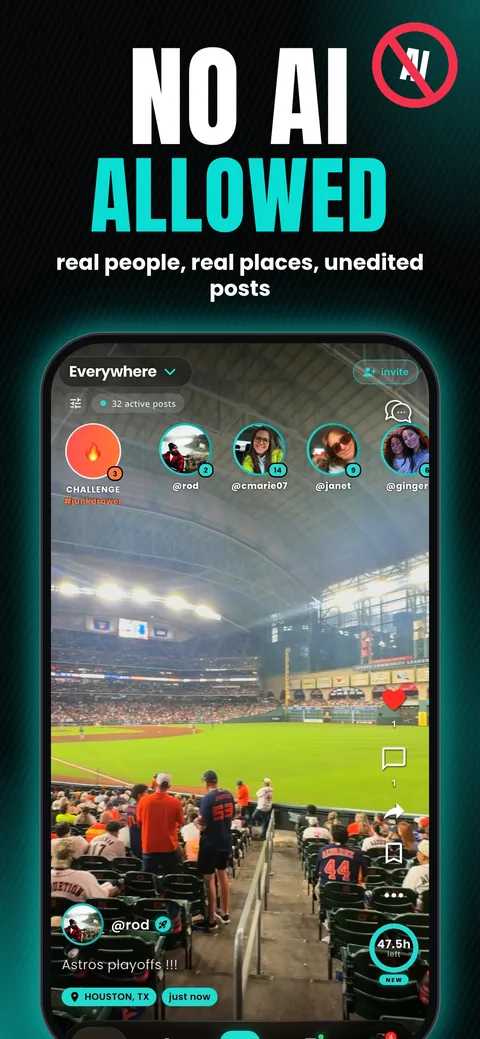
Portal is a camera-only social app: everything is filmed live in the app, posts leave the feed after 48 hours, and location is shown at the city level only. Here's how the lessons above shape what we're building.
- School pages. Every school has its own home on Portal, like our high school pages and school directory, so a school becomes a place on the app, not just a field in a profile.
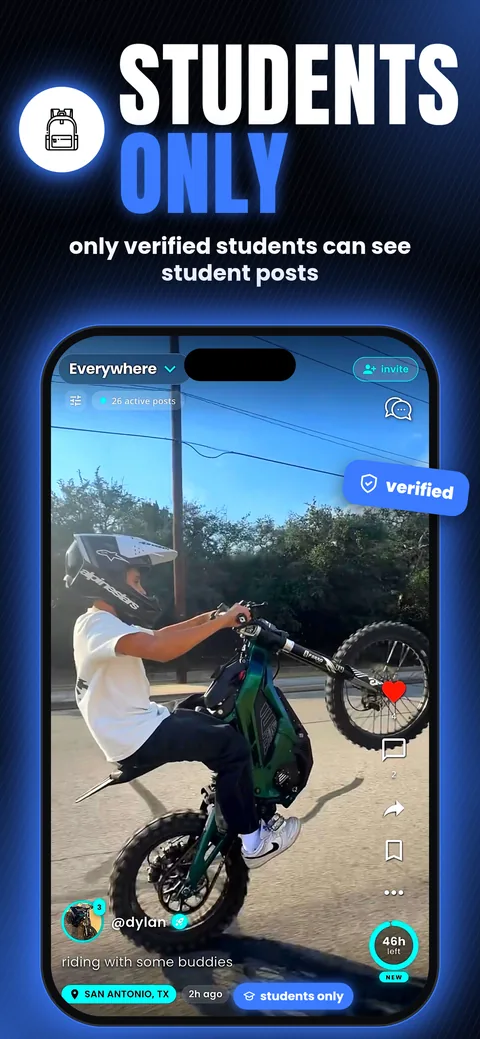
- A students-only layer. Students verify their school in the app, and student-only posts are visible only to other verified students. It's designed so adults aren't in that feed, and adults can't DM students. Verification is the trust layer that Gas lacked and Facebook's school emails provided.
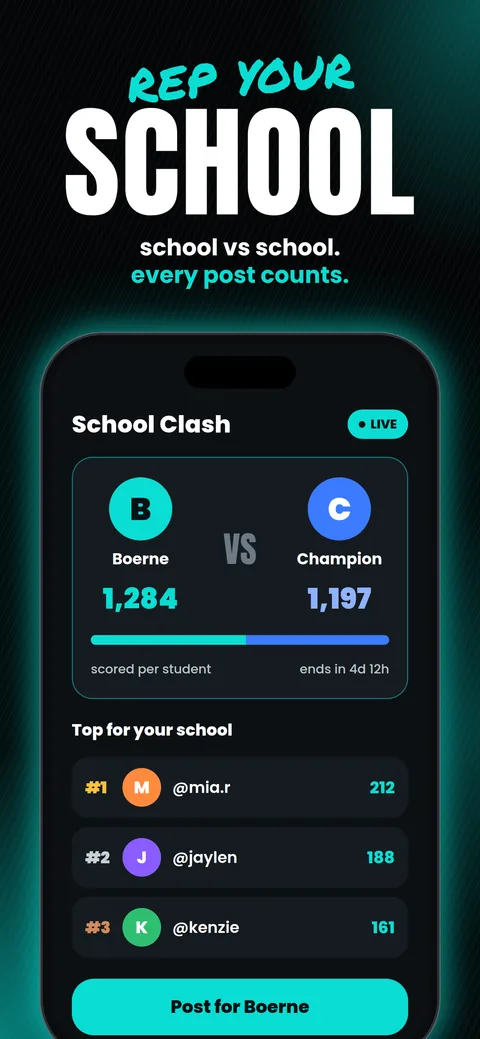
- Per-student Clash scoring. In School Clash, schools compete head to head and are scored per student, so a smaller school can win. That rewards density, which is the metric that actually matters, rather than raw size.
- Retention through habits, not just novelty. Streaks, 1v1 challenges and leaderboards from friends up to national give people a reason to come back after the launch spike.
- Starting with two schools. Our first Clash is Boerne High vs Champion High in Boerne, Texas, October 19 to 31, 2026. Two schools in one town, one existing rivalry, one bounded network. It's run by Portal Tech, Inc. and isn't affiliated with either school or Boerne ISD.
The takeaway
The history here is consistent: the apps that won young users started small and dense, used the school as the unit of growth and rode existing social structures. The ones that faded often had the launch without the habit, or the reach without the trust.
Portal is our attempt to take the parts that worked, school-level density, bounded trust and real rivalries, and pair them with a product people have a reason to open every day. If you're an investor or operator thinking about this space, our investor page is the place to start.
Frequently asked questions
How did Facebook spread to colleges?
Facebook launched at Harvard in February 2004, opened to other universities a month later, added high schools in September 2005 and opened to anyone 13 and older in September 2006.
How did the TBH app grow so fast?
TBH launched at one school in Georgia, where co-founder Nikita Bier said 40 percent of students downloaded it on day one. Facebook acquired it in October 2017 and shut it down in 2018.
What happened to the Gas app?
Gas launched in August 2022, hit No. 1 on the U.S. App Store, was acquired by Discord in January 2023 and was shut down in November 2023.
Did BeReal use campus ambassadors?
Yes. BeReal's spread on college campuses was helped in part by a paid student ambassador program that promoted the app and hosted campus events.
Why do social apps launch school by school?
A school is a dense, pre-built social network. Launching there makes the app feel full immediately, which is hard to achieve with a broad launch.
Real videos. Real people. Your school keeps score.
Camera-only, no AI. Free on iPhone, 13+.